Overview
Inside Saudi’s Tech Transformation
Get exclusive weekly insights into how the Kingdom is powering Vision 2030.
Summarize this blog post with your preferred AI:
TL;DR
- Off-the-shelf software is faster and cheaper upfront, but forces your business to adapt to the tool.
- Custom software development costs more initially but delivers a competitive advantage, scalability, and long-term ROI.
- The smartest strategy is often a hybrid approach: buy for standard functions, and build where differentiation matters.
- Veroke has helped clients like DoorLab and BuildHub transform through purpose-built custom platforms.
Every business eventually faces the same technology question: Should we buy an existing software solution or invest in custom software development?
The answer is rarely straightforward. While off-the-shelf software offers speed and lower upfront costs, custom software development services provide flexibility, scalability, and a competitive advantage when your business needs extend beyond standard workflows.
Making the wrong decision can lead to wasted budgets, operational bottlenecks, and expensive migrations later. This guide provides a practical framework to help business leaders determine when to build and when to buy.
The Core Difference
Off-the-Shelf Software: Built for Everyone
Off-the-shelf software is a pre-built solution designed to serve a broad range of businesses and industries. Common benefits include:
- Faster implementation
- Lower upfront investment
- Established support ecosystems
- Frequent vendor updates
However, these solutions often require businesses to adapt their processes to fit the software, not the other way around.
Custom Software Development: Built for You
Custom software is designed and developed specifically for your organization’s unique requirements, workflows, and objectives.
At Veroke, custom software development are built around your business goals, ensuring scalability, seamless integration, and long-term adaptability.
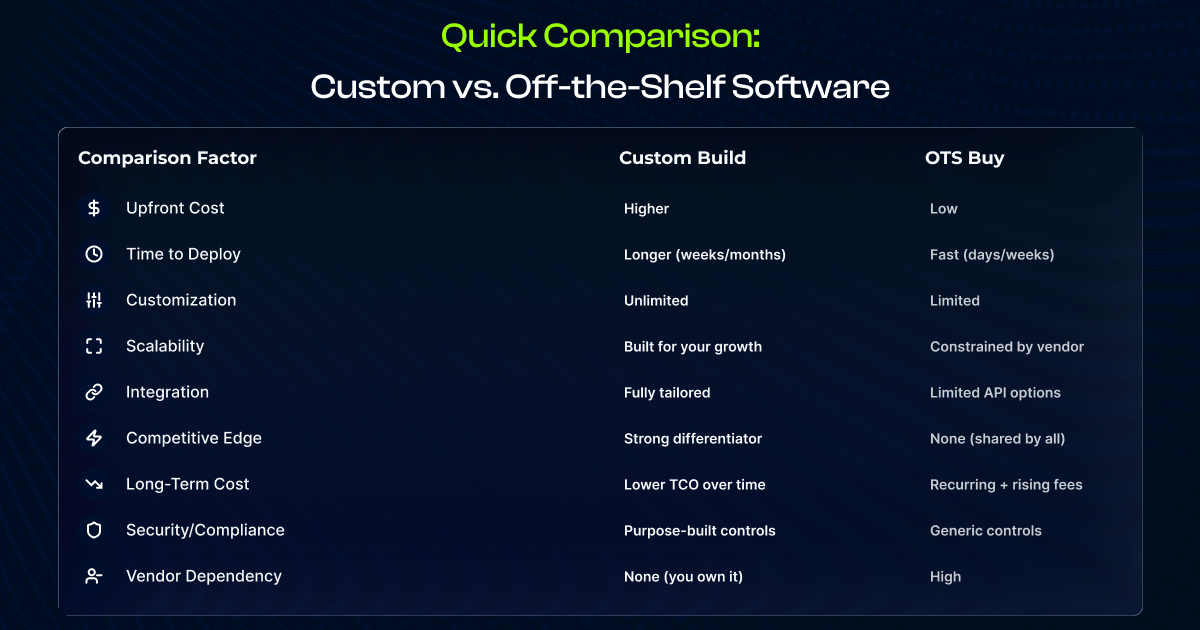
Custom software vs Off-the-Shelf Software Comparison
The Real Cost of “Buying”
Many businesses assume buying software is always cheaper. In reality, the total cost of ownership (TCO) often includes:
- Subscription fees
- Per-user licensing costs
- Integration expenses
- Customization limitations
- Vendor lock-in
- Migration costs later
As organizations grow, these recurring expenses can exceed the cost of building a tailored solution. The key question isn’t: “What costs less today?” It’s: “Which option creates more value over the next 3–5 years?”
When Off-the-Shelf Software Makes Sense
Buying is often the right choice when software supports a standard business function rather than creating competitive differentiation.
Choose Off-the-Shelf Software If
1. Your Requirements Are Common
If your needs align with industry-standard processes, existing software may already solve the problem effectively.
2. Speed Is Critical
When immediate deployment matters more than customization, pre-built solutions offer a faster path to implementation.
3. Budget Constraints Are Significant
Startups and early-stage businesses often benefit from validating their business model before investing in custom development.
4. The Software Isn’t Core to Your Competitive Advantage
If the system doesn’t directly impact customer experience, revenue generation, or operational differentiation, buying may be sufficient.
When to Choose Custom Software Development
Building software becomes valuable when technology directly influences business performance, customer experience, or operational efficiency.
Choose Custom Software If
1. Your Processes Are Unique
If your team relies on specialized workflows, forcing them into generic software often reduces efficiency. Custom software development supports the way your business operates instead of requiring your business to adapt.
2. You Need Competitive Differentiation
Many successful digital products exist because off-the-shelf tools couldn’t deliver the desired experience. If software is central to your value proposition, custom development can become a strategic asset.
3. Integration Is Complex
Organizations often operate across multiple systems, platforms, and data sources. Custom software enables seamless integration between ERP systems, CRMs, customer portals, third-party APIs, and internal databases.
4. Scalability Is a Priority
Business growth often exposes limitations in pre-built platforms. Custom software development allows organizations to scale functionality, users, and infrastructure without being constrained by vendor roadmaps.
5. Security and Compliance Requirements Are Strict
Industries such as healthcare, fintech, logistics, and enterprise services often require customized security controls and compliance frameworks. Custom development allows organizations to design systems around their specific regulatory obligations and risk profiles.
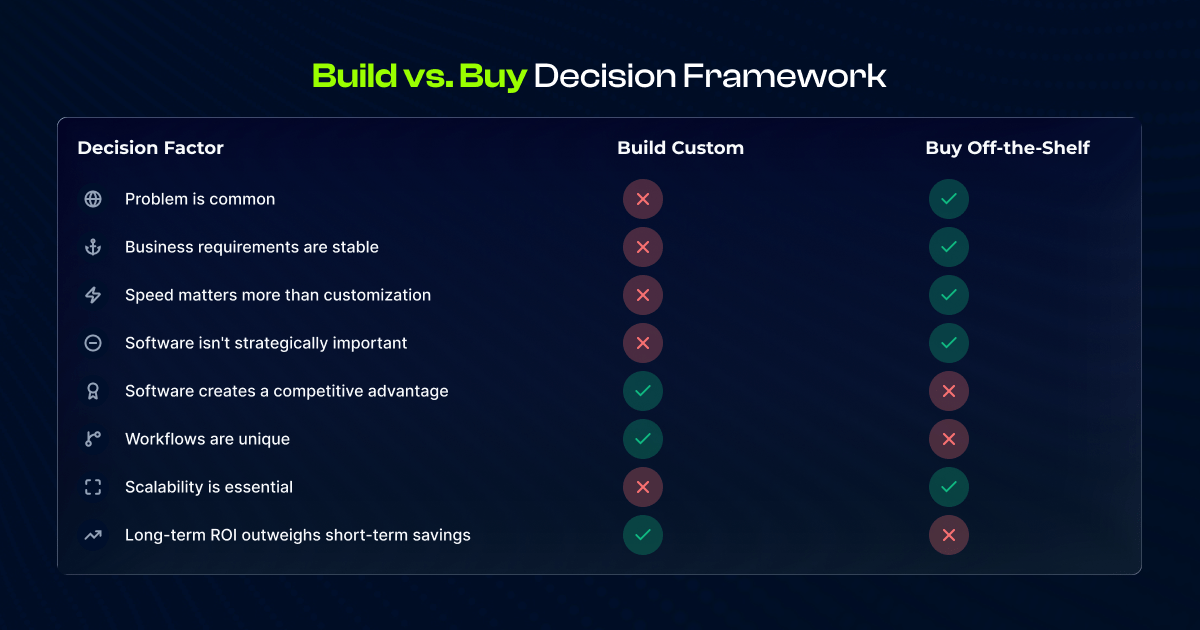
Build vs. Buy Decision Framework
Veroke Case Studies
How Custom Software Transformed DoorLab
DoorLab, a medical diagnostics provider serving both private and public healthcare sectors in Saudi Arabia, was struggling with an underperforming app that couldn’t keep pace with user expectations or market demands.
DoorLab approached Veroke to build a purpose-built platform. Veroke’s team analyzed the existing application, identified key performance gaps, and executed a strategic transformation, repositioning DoorLab as an e-commerce-style healthcare platform with test selection, order tracking, prescription-based discount packages, and home lab services.
The custom solution rapidly boosted DoorLab’s revenue, positioned them as a key player in Saudi Arabia’s health-technology landscape, and gave them the scalability to serve growing public and private sector demand.
BuildHub – Digitizing a Fragmented Industry
The building materials industry remained largely offline and fragmented; buyers and sellers had no efficient digital channel to connect, negotiate, or transact.
Veroke built BuildHub, an innovative online platform that automates manual tasks, streamlines order management from initiation to delivery, and enables real-time communication and negotiation between buyers and sellers.
BuildHub transformed how building materials are bought and sold, bringing transparency, efficiency, and digital capability to a traditionally inefficient market.
No existing off-the-shelf platform could serve this niche. Custom development gave the client a proprietary market advantage.
The Hybrid Approach: Often the Smartest Option
Most businesses don’t face a clean binary choice. In practice, the smartest technology strategies are rarely “all custom” or “all off-the-shelf”; they’re a deliberate mix of both.
The hybrid approach works on a simple principle: use existing tools where your business is standard, build custom where your business is unique. This keeps costs controlled without sacrificing the competitive edge that custom development delivers in the areas that actually matter.
For growing businesses, especially, this is often the most practical path: start with off-the-shelf tools to move quickly, identify where those tools create friction or limit growth, and then invest in custom development precisely where it unlocks the most value. Veroke’s team regularly helps businesses map this kind of hybrid architecture, identifying what to keep, what to replace, and what to build from scratch.
Questions to Ask Before Making a Decision
Before choosing custom or off-the-shelf software, ask:
- Is this software part of our competitive advantage?
- Will our requirements change significantly in the next three years?
- What are the long-term licensing costs?
- How difficult will integrations become as we scale?
- Are we adapting our business to the software, or should the software adapt to us?
The answers often make the right path clear.
Final Thoughts
There is no universally correct answer in the custom software versus off-the-shelf debate. The best choice depends on your business goals, growth plans, operational complexity, and competitive strategy.
Off-the-shelf software works well for standard processes and rapid deployment. Custom software development becomes valuable when technology is a strategic enabler of growth, innovation, and differentiation.
Organizations that evaluate software decisions through a long-term business lens, not just initial costs, typically achieve stronger returns and greater operational flexibility.
If you’re assessing whether to build or buy, working with an experienced technology partner can help you avoid costly mistakes and create a roadmap aligned with your business objectives. With expertise in custom software development, product engineering, AI solutions, DevSecOps, UX/UI design, and staff augmentation, Veroke helps organizations build scalable digital systems designed for long-term success.
FAQs
1. Is custom software development more expensive than buying off-the-shelf?
Initially, yes, custom software has higher upfront costs. However, over 3–5 years, recurring subscription fees, per-user licensing, and integration costs of off-the-shelf software often exceed the total cost of ownership for a custom solution. Veroke’s clients typically see long-term savings and competitive advantages.
2. Can Veroke help decide whether to build or buy?
Veroke offers strategic technology consulting alongside development services. Our team helps businesses assess requirements, map workflows, and recommend the most cost-effective and scalable approach, whether that’s custom development, hybrid architecture, or optimizing existing tools. Get in touch here.
3. Can I integrate custom software with my existing off-the-shelf tools?
One of the primary advantages of custom software is seamless integration with ERP systems, CRMs, third-party APIs, and internal databases. Veroke specializes in building systems that connect your entire technology stack.
4. What is a hybrid software strategy?
A hybrid approach combines off-the-shelf tools for standard functions (e.g., accounting, HR) with custom-built components for competitive advantages (e.g., customer portals, proprietary analytics). This balances cost-efficiency with innovation.
5. How does Veroke ensure long-term scalability in custom software?
Veroke structures engagements around long-term continuity, not just delivery. With dedicated engineering teams, embedded DevSecOps, and architectural documentation, Veroke ensures systems survive change, scale, and regulatory pressure. Read about Veroke’s engagement models.
Want to know more about our service.
Inside Saudi’s Tech Transformation
Get exclusive weekly insights into how the Kingdom is powering Vision 2030.
Subscribe to Get Latest Insights
Transform your Ideas into a Digital Reality
Get scalable, customized solutions for your business.