
Overview
Inside Saudi’s Tech Transformation
Get exclusive weekly insights into how the Kingdom is powering Vision 2030.
Summarize this blog post with your preferred AI:
TL;DR
- Fintech UX performance is primarily driven by how effectively friction is removed while maintaining strong user trust throughout every interaction.
- Simplified onboarding, especially around identity verification and financial setup, is critical for preventing early user drop-off and improving activation rates.
- Clear financial presentation, transparent transaction flows, and intuitive mobile-first design significantly increase user confidence and completion of key actions.
- Continuous optimization through testing, personalization, and accessibility improvements is essential for sustaining engagement and long-term retention.
Fintech products operate in a high-trust, high-friction environment where users are asked to share sensitive financial and identity data within seconds of first interaction. As a result, even small UX issues can lead to immediate drop-offs.
Research across fintech onboarding journeys shows that more than half of users abandon the process during onboarding, particularly at identity verification (KYC) steps, making it one of the most critical friction points in digital financial services.
Even after onboarding begins, trust remains a major barrier. Studies and behavioral patterns indicate that a lack of clear trust signals in early interactions can cause roughly one in three users to abandon fintech apps after their first experience, especially when security, transparency, or legitimacy is unclear.
In this context, fintech UX is not just about usability; it is a direct driver of conversion, trust, and user retention.
This article breaks down UI/UX best practices that help fintech products reduce friction, build trust, and improve conversion rates.
Why UI/UX Matters More in Fintech?
Unlike entertainment apps or social media platforms, fintech products operate in an environment where mistakes can have real financial consequences.
Users evaluate fintech experiences through three critical lenses:
- Trust
- Simplicity
- Reliability
A poorly designed interface can lead to:
- Abandoned registrations
- Failed KYC verification processes
- Incomplete transactions
- Lower customer retention
- Increased support requests
A well-designed experience creates confidence, reduces friction, and encourages users to engage with financial services more frequently.
For fintech companies, UI/UX is not simply a design consideration; it’s a business growth strategy. Below are 10 UI/UX best practices that consistently drive better user experiences and business outcomes:
1. Build Trust from the First Screen
Trust is the single most important factor in fintech conversion.
Before users create accounts, connect bank information, or transfer funds, they need reassurance that their money and personal data are protected.
Best Practices
- Display security badges and compliance certifications
- Clearly explain data encryption and privacy measures
- Maintain consistent, professional visual design
- Make privacy policies and terms easy to access
- Use trust-building messaging throughout onboarding
Trust signals reduce hesitation and help users move confidently through the customer journey.
2. Simplify User Onboarding
One of the biggest conversion killers in fintech is a lengthy registration process.
While compliance requirements often require extensive information collection, users should never feel overwhelmed during onboarding.
Best Practices
- Break registration into smaller steps
- Use progress indicators
- Enable biometric authentication
- Allow limited product exploration before verification
- Provide contextual guidance during KYC procedures
Reducing onboarding friction can dramatically improve activation rates and customer acquisition performance.
3. Design for Financial Clarity
Financial information is often complex, especially for first-time users. The role of fintech UX is to simplify complexity, not amplify it.
Best Practices
- Use clear visual hierarchies
- Highlight critical account information
- Replace industry jargon with plain language
- Present insights through charts and visualizations
- Focus user attention on key actions
Users who quickly understand their financial position are more likely to engage regularly with the platform.
4. Prioritize Mobile-First Experiences
Mobile devices have become the primary channel for financial interactions. Designing for desktop first often creates usability issues that negatively affect mobile conversion rates.
Best Practices
- Design for one-handed navigation
- Use thumb-friendly touch targets
- Minimize typing requirements
- Reduce form complexity
- Optimize performance and loading speed
A frictionless mobile experience improves acquisition, engagement, and retention.
5. Make Security Feel Effortless
Security should be highly visible without creating unnecessary barriers. The most successful fintech products make protection feel seamless rather than intrusive.
Best Practices
- Implement biometric authentication
- Use adaptive security measures
- Explain verification requirements clearly
- Send real-time account activity notifications
- Maintain transparent security communication
The ideal balance is strong protection paired with minimal user effort.
6. Use Smart Personalization
Modern users expect experiences tailored to their financial goals and behavior. Personalization increases relevance and encourages long-term engagement.
Best Practices
- Display personalized insights
- Recommend relevant financial products
- Customize dashboards
- Provide contextual alerts and reminders
Personalized experiences create stronger customer relationships and higher product adoption.
7. Create Transparent Transaction Flows
Transactions are often the highest-risk moments in a fintech journey. Users need complete confidence when transferring money, investing funds, or making financial decisions.
Best Practices
- Provide transaction summaries before submission
- Display fees upfront
- Offer confirmation screens
- Show estimated processing times
- Deliver real-time status updates
Transparency reduces anxiety and increases transaction completion rates.
8. Reduce Cognitive Load
Many fintech products overwhelm users with excessive information, notifications, and functionality. Effective UX focuses attention on what matters most.
Best Practices
- Use progressive disclosure
- Prioritize primary actions
- Remove unnecessary visual clutter
- Simplify navigation structures
- Limit non-essential notifications
A focused experience helps users make decisions more quickly and confidently.
9. Design Accessible Financial Experiences
Accessibility is no longer optional. Inclusive fintech design expands market reach while improving usability for all users.
Best Practices
- Maintain sufficient color contrast
- Support screen readers
- Use readable typography
- Design for varying levels of financial literacy
- Provide clear content structures
Accessible experiences often improve engagement across all customer segments, not just users with disabilities.
10. Continuously Test and Optimize
Successful fintech products are never truly finished. Customer expectations, regulations, technologies, and market conditions evolve continuously.
Best Practices
- Conduct usability testing regularly
- Analyze behavioral analytics
- Run A/B tests on critical flows
- Gather customer feedback
- Monitor onboarding and transaction drop-offs
The highest-performing fintech products are built through ongoing iteration and optimization.
Veroke Fintech Experiences
How Better UI/UX Drives Fintech Growth
The relationship between UI/UX and business performance is particularly strong in financial technology.
Strategic UI/UX improvements can help organizations:
- Increase onboarding completion rates
- Improve transaction success rates
- Reduce customer acquisition costs
- Increase product adoption
- Improve retention and loyalty
- Lower support and operational costs
For fintech companies competing in crowded markets, superior user experience often becomes a key differentiator.
How Veroke Improves Fintech Digital Experiences
At Veroke, we’ve helped fintech companies transform complex financial workflows into intuitive digital experiences that users trust and adopt.
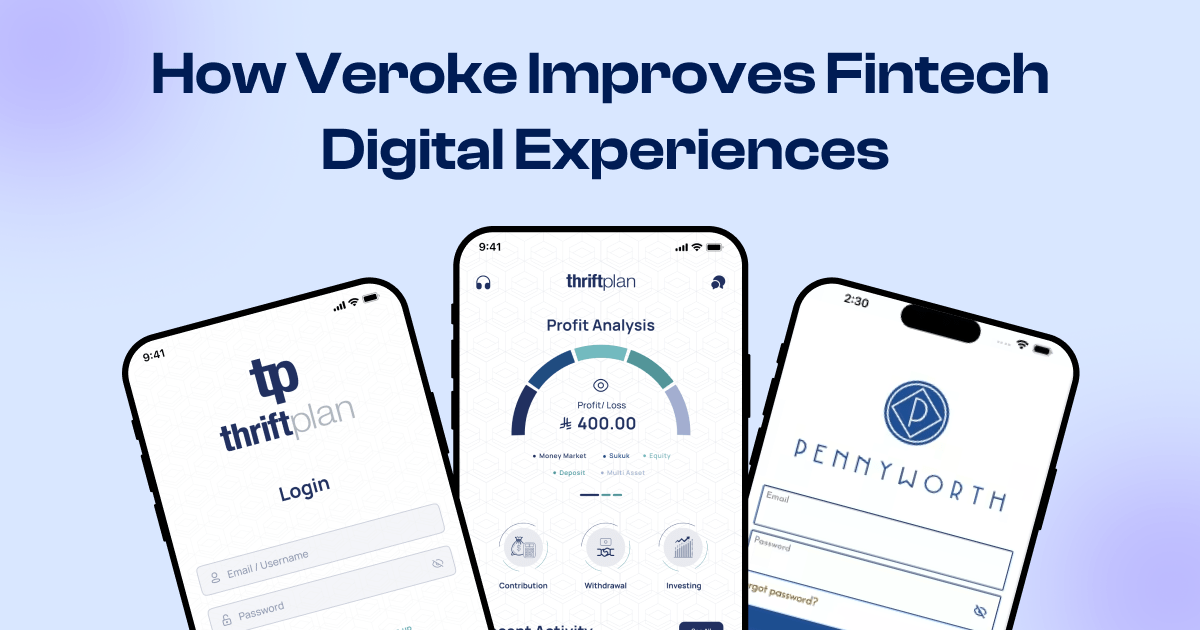
Pennyworth: Simplifying Personal Financial Management
Pennyworth, a UK-based fintech startup founded by former Barclays executives, aimed to create a digital private banker powered by open banking technology.
Veroke led frontend development across mobile platforms, creating a user experience that consolidated multiple financial accounts into a single, intuitive interface. By prioritizing clarity and usability, the platform helped users gain a comprehensive view of their financial health without complexity.
The result was strong early adoption, high customer satisfaction, and a highly rated mobile experience.
ThriftPlan: Improving Financial Wellness Through Better UI/UX
ThriftPlan sought to modernize employee savings and retirement planning for organizations in Saudi Arabia.
Veroke designed and developed web and mobile experiences focused on financial clarity, accessibility, and ease of use. The platform simplified savings contributions, employer participation, and long-term financial planning.
By removing friction from financial management workflows, ThriftPlan successfully onboarded thousands of users and facilitated substantial contribution growth within its first year.
Ready to Build a Fintech Product Users Trust?
Exceptional fintech experiences don’t happen by accident. They are the result of strategic design decisions that prioritize trust, simplicity, and customer needs.
At Veroke, we combine user-centered design, product strategy, and software engineering to build fintech solutions that are secure, scalable, and conversion-focused. Whether you’re launching a fintech startup, developing an MVP, or modernizing an existing financial platform, our team helps transform complex financial services into intuitive digital experiences that drive measurable business growth.
Explore our fintech development services and discover how Veroke helps financial innovators bring better products to market.
Frequently Asked Questions
1. Why do users drop off during fintech onboarding?
Most users abandon fintech onboarding because of KYC friction, unclear steps, or lack of trust signals. Long forms, unclear verification timelines, and missing transparency around data usage significantly increase drop-off rates.
2. What is the biggest UX challenge in fintech?
The biggest UX challenge in fintech is balancing robust security with a seamless user experience, ensuring users’ financial data remains protected without introducing unnecessary friction or complexity.
3. How important is onboarding UX in fintech?
Onboarding is the most critical stage. If users don’t complete onboarding, no other feature matters. Most fintech apps lose a majority of users during registration or KYC due to friction and uncertainty.
4. How does mobile-first design improve fintech conversions?
Mobile-first design improves accessibility, speed, navigation, and usability on the devices most users rely on, resulting in higher engagement and conversion rates.
5. How often should fintech companies conduct UX testing?
UX testing should be an ongoing process. Leading fintech organizations continuously evaluate user behavior, gather feedback, and optimize experiences based on data.
Want to know more about our service.
Inside Saudi’s Tech Transformation
Get exclusive weekly insights into how the Kingdom is powering Vision 2030.
Subscribe to Get Latest Insights
Transform your Ideas into a Digital Reality
Get scalable, customized solutions for your business.